Two words, very different budgets
If you are about to fund a game, "game prototype vs production build" is not a technical distinction — it is a budgeting decision. The two words sit at opposite ends of cost, time, and risk, and confusing them is how studios and clients end up disappointed with each other. A prototype is meant to be rough. A production build is meant to be finished. Paying production prices for a prototype is waste; expecting production quality from a prototype budget is a misunderstanding that surfaces at the worst possible moment.
Every game idea carries two separate risks, and they are easy to blur together. The first is whether the idea is actually fun — whether anyone, including you, will want to play it. The second is whether the game can be built to the standard you are imagining, on a budget and timeline you can live with. These are different questions, and the expensive mistake is trying to answer both at once with a single large cheque.
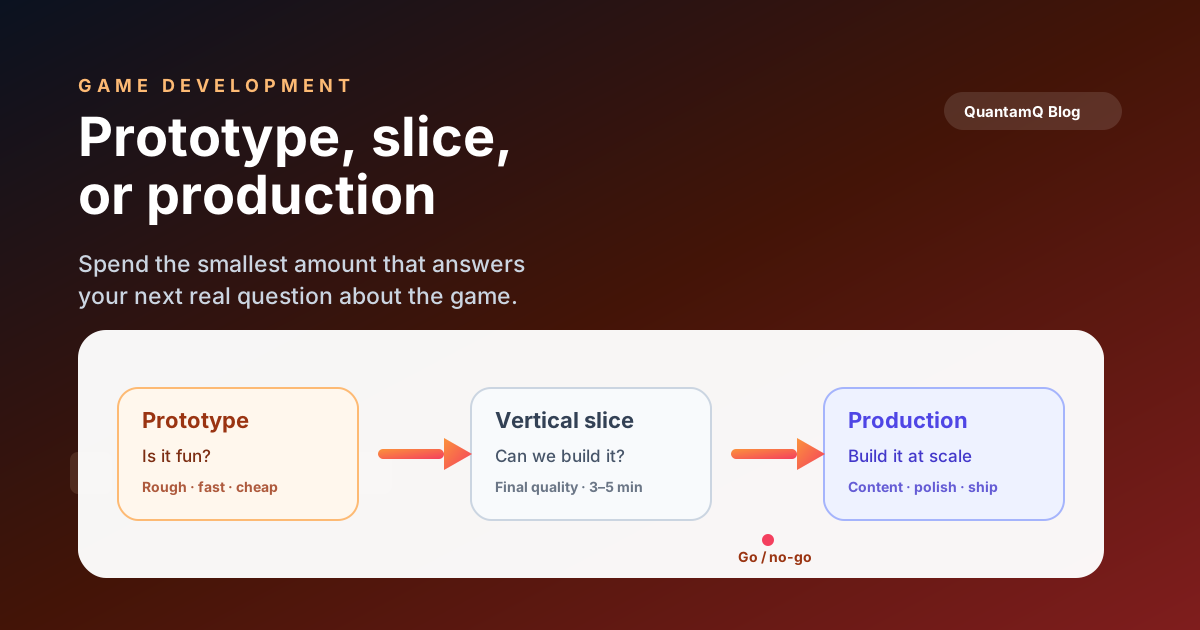
A prototype answers the first question cheaply. A production build answers the second by simply doing it, at full cost. The stage in between — the vertical slice — exists because jumping straight from "this is fun" to "build the whole thing" skips the most dangerous unknown: can this team make this game, to this quality, repeatedly, for months. Treating these as three distinct purchases, each with a decision gate, is what keeps a game project from quietly overrunning.
What a prototype proves
A prototype exists to test one thing: is the core idea fun? It is deliberately ugly and fast. Placeholder art, no audio polish, a single level or even a single mechanic — whatever is needed to get a controller or a screen in front of a player and watch what happens. The point is not to impress anyone. It is to find out, as cheaply as possible, whether the central loop produces genuine engagement or only looked good on a pitch deck.
The signal you are looking for is repeatable fun. A mechanic that delights once and never again is a novelty, not a game. A good prototyping phase puts the build in front of several different players and watches for consistency: do they understand what to do, do they want another go, do they push the system in ways you did not script. If that holds up, you have de-risked the most fundamental unknown for a fraction of a production budget.
A small playable prototype can land somewhere in the region of US$10,000 to US$50,000, with the low end covering a single tight mechanic and the high end covering systems-heavy or multiplayer concepts that need real engineering just to be testable. The exact number depends entirely on scope, so treat any figure as planning guidance, not a quote. What matters is the ratio: a prototype should cost a small fraction of the full build, because its job is to tell you whether the full build is worth funding at all.
The vertical slice in between
The stage most clients have never heard of is the one that prevents the most pain. A vertical slice is a short section of the game — often three to five minutes of play — built at final quality across every discipline: art, audio, interface, and code. Where a prototype proves the game is fun, the vertical slice proves you can actually make it to the intended standard. As one common framing puts it, prototypes help you decide whether you should make the game; the vertical slice helps you decide whether you can.
The slice does several useful jobs at once. It sets the quality bar that the rest of production has to match, so there is a concrete reference instead of a vague aspiration. It forces the team to build and test the real pipelines and tools the full game will run on. And because it looks and feels like the finished product, it becomes the asset you show to publishers, platforms, or investors when you need funding to continue.
A vertical slice typically takes one to three months and costs accordingly — more than a scrappy prototype, far less than a full build. The discipline is to keep it narrow. A vertical slice is not a demo level you polish forever, and it is not the first chapter of the game. It is the smallest complete-quality sample that answers the "can we build this?" question honestly.
What a production build actually is
Production is where the majority of the game gets made, and it is by far the longest and most expensive phase. With the vertical slice setting the standard, production is the work of building out content at that quality and scale: all the levels, systems, art, audio, balancing, optimisation, platform certification, and the long tail of testing and bug-fixing that turns a convincing slice into a shippable product.
The cost reflects that scope. Very small production builds can start around US$25,000 at the tightly-scoped end, while more substantial indie or branded games can move into the hundreds of thousands, with development spanning months to a couple of years. Larger and more complex titles climb well beyond that. The wide range is not vagueness — it is the difference between a focused web or mobile title and an ambitious multi-system game, and it is exactly why the earlier stages exist to pin scope down before you commit to it.
The biggest mistake teams make is rushing into production before the earlier questions are answered. When a project enters production without a proven core loop, a settled art direction, and a scoped feature roadmap, production becomes reactive — full of rework, redesign, and "just one more change" — and the budget that was meant to build the game gets spent rediscovering what it should have been.
Deciding what to commission next
You rarely need to decide the whole journey up front. You need to decide the next stage. The honest question is which unknown is currently the most expensive, and which stage retires it most cheaply.
- If you do not yet know whether the idea is fun, commission a prototype. Anything more is paying to polish something that might not be worth making.
- If the idea is proven fun but you do not know whether it can be built to quality — or you need an asset to raise money or win a platform slot — commission a vertical slice.
- If the core loop is repeatably fun, the art direction is settled, and you have a scoped roadmap and a credible estimate, you are ready for production.
How we stage game work
At QuantamQ we treat a game the way we treat any serious build: stage the spend so each decision is cheap and well-informed. We prototype to test the core loop before anyone talks about content, use a tightly-scoped vertical slice to prove the quality bar and the pipeline, and only then plan production against a real feature roadmap and a documented estimate. For web and mobile titles this maps cleanly onto our Game Development work, and where a game ships as a mobile product the production phase shares the same delivery discipline as our Mobile Apps builds.
The aim is the same at every gate: make your next decision the smallest one that moves the project forward with confidence. Whether that decision is to keep building, to narrow the scope, or to stop, you should always know which question your money is currently buying an answer to.
Frequently asked questions
What is the difference between a game prototype and a production build?
A prototype is a rough, fast build that tests whether the core idea is fun and worth making. A production build is the full, polished game made at quality and scale after that question has been answered. They sit at opposite ends of cost, time, and risk.
What does a game prototype cost?
A small playable prototype can land somewhere between roughly US$10,000 and US$50,000 depending on complexity, with simple single-mechanic prototypes lower and systems-heavy ones higher. Treat any figure as planning guidance until the scope is defined.
What is a vertical slice in game development?
A vertical slice is a short section of the game — often three to five minutes — built at final quality across art, audio, and code. It proves you can actually make the game to the intended standard, not just that the idea is fun.
When should I move from prototype to production?
Move forward when the core mechanic is repeatably fun across several playtests with different players, the art direction is settled, and the team has a scoped feature roadmap and estimate. If fun only appears occasionally, stay in prototyping.